 Türkçe
 العربية
 Deutsch
 English
 Español
 Français
 Italiano
 Português
 Русский
 Tiếng Việt


URL Encoding and Decoding Demystified: The RFC 3986 Developer Guide to Percent-Encoding
Everything you need to know about reserved characters, query strings, UTF-8 octets, and security vulnerabilities.
 By LinkeFly Editorial Team
In the modern web architecture of RESTful APIs, Single-Page Applications (SPAs), and complex query strings, the Uniform Resource Identifier (URI) is the fundamental addressing mechanism. However, raw internet transmission requires that characters outside the standard US-ASCII repertoire—as well as characters with reserved structural meanings—be converted into a safe, unambiguous format. This process is known as Percent-Encoding or URL Encoding.
Improperly encoded or prematurely decoded URLs lead to broken application state, malformed API payloads, subtle parsing bugs, and critical web security vulnerabilities such as path traversal and cross-site scripting (XSS). In this comprehensive technical guide, we break down RFC 3986, examine how UTF-8 octets are serialized, and share architectural best practices for web developers.
1. Why Do URLs Require Percent-Encoding?
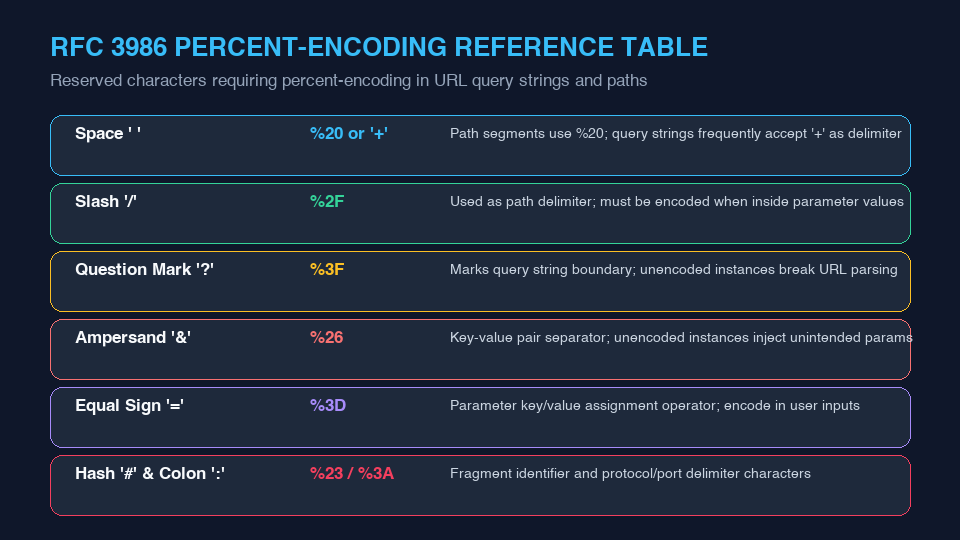
The URI syntax specification (RFC 3986) strictly partitions the 128 US-ASCII characters into three discrete groups:
- Unreserved Characters: Letters (
A-Z,a-z), digits (0-9), hyphens (-), underscores (_), periods (.), and tildes (~). These characters never require encoding. - Reserved Characters: Characters that have syntactic structural meanings within a URI, including delimiters like
: / ? # [ ] @ ! $ & ' ( ) * + , ; =. - Illegal Characters: Whitespace, control characters (ASCII 0-31 and 127), and any non-ASCII Unicode characters (such as accents, emojis, or international alphabets).
When reserved characters are used as raw data inside query parameter values (for example, searching for the string "Tom & Jerry"), they conflict with URI parsing rules. In that scenario, the ampersand (&) would be misinterpreted as a key-value parameter separator rather than part of the search query. Percent-encoding replaces such characters with a percent sign (%) followed by the two-digit hexadecimal representation of their ASCII byte value.
2. How Percent-Encoding Works at the Byte Level
To convert an arbitrary character or Unicode code point into percent-encoded form:
- The character is encoded into binary octets (bytes) using the UTF-8 character encoding.
- For ASCII characters (code points 0–127), the single byte is converted to hexadecimal. For example, a space character (ASCII 32, hex
20) becomes%20. - For multi-byte Unicode characters, each individual UTF-8 byte is prepended with
%. For example, the Euro symbol (€) encodes in UTF-8 as three bytes:0xE2 0x82 0xAC. Its valid percent-encoded URI representation is%E2%82%AC.
The Space Conundrum: %20 vs +
Web developers frequently encounter confusion between %20 and +. Under RFC 3986, %20 is the universal percent-encoding for a space across all URI segments. However, the legacy HTML form standard (application/x-www-form-urlencoded) historically permitted the plus sign (+) to replace spaces in query strings. For RESTful path segments, always use %20; for query strings, modern web frameworks generally decode both transparently.
3. Security Pitfalls: Double-Encoding and Path Traversal
Improper URL decoding order is a leading source of web application firewalls (WAF) bypasses and remote file inclusion:

- Double Percent-Encoding: An attacker submits
%2520. If an intermediate reverse proxy decodes%25to%, leaving%20, and the backend application server decodes it again into a raw space, security filters checking for unauthorized characters are completely bypassed. - Directory Traversal (
..%2F): Attackers encode dots and forward slashes (e.g...%2F..%2Fetc/passwd) to evade naive substring checks likeif (path.includes('../')).
4. Developer Best Practices for Clean Encoding
- Encode Data, Never Full URLs: Only apply percent-encoding to individual parameter values. Encoding an entire URL string will convert protocol slashes (
https://) intohttps%3A%2F%2F, breaking browser routing completely. - Use Standard Native Methods: In JavaScript, use
encodeURIComponent()for query values rather than deprecated functions likeescape(). In Python, leverageurllib.parse.quote()andquote_plus(). In PHP, employrawurlencode()for strict RFC 3986 compliance. - Decode Exactly Once: Ensure your application framework processes URL decoding at the ingress routing boundary and does not perform subsequent manual decoding calls downstream.
Instant Free Tool on LinkeFly
Need to rapidly test, debug, or verify encoded query strings without writing temporary scripts? Utilize our fast, client-side LinkeFly URL Encode Tool and URL Decode Tool to inspect and transform strings instantly with zero data transmission to external servers.
Frequently Asked Questions (FAQ)
encodeURI() is designed for full URIs and preserves reserved structural characters such as /, :, and ?. In contrast, encodeURIComponent() encodes all reserved characters including slashes and question marks, making it mandatory for individual query parameter keys and values.%2f and %2F are semantically equivalent). However, RFC 3986 strongly recommends uppercase hexadecimal digits (%2F) for canonical consistency across caching proxies.