 Türkçe
 العربية
 Deutsch
 English
 Español
 Français
 Italiano
 Português
 Русский
 Tiếng Việt


UUID and GUID Architecture: The Distributed Database Guide to Primary Keys and RFC 9562
Why sequential auto-increment IDs fail in distributed systems, UUID v4 vs v7, and B-Tree indexing.
 By LinkeFly Editorial Team
In the early days of monolithic web applications, assigning database primary keys was straightforward: developers configured an auto-incrementing integer (1, 2, 3...). However, in today's era of horizontally partitioned microservices, multi-region distributed databases, and high-concurrency offline mobile clients, sequential integers break down catastrophically.
Sequential IDs create single-point-of-failure database bottlenecks, expose predictable ID enumeration vulnerabilities to competitors, and cause irreconcilable collision conflicts during database replication. Enter the Universally Unique Identifier (UUID)—also known in Microsoft ecosystems as the Globally Unique Identifier (GUID). In this architectural guide, we dissect UUID anatomy, evaluate RFC 4122 vs the new RFC 9562 standards, and explore database B-Tree index optimization.
1. The Anatomy of a 128-Bit UUID
A UUID is an exact 128-bit (16-byte) binary integer represented as a 36-character string consisting of 32 hexadecimal digits and four separating hyphens in an 8-4-4-4-12 pattern:
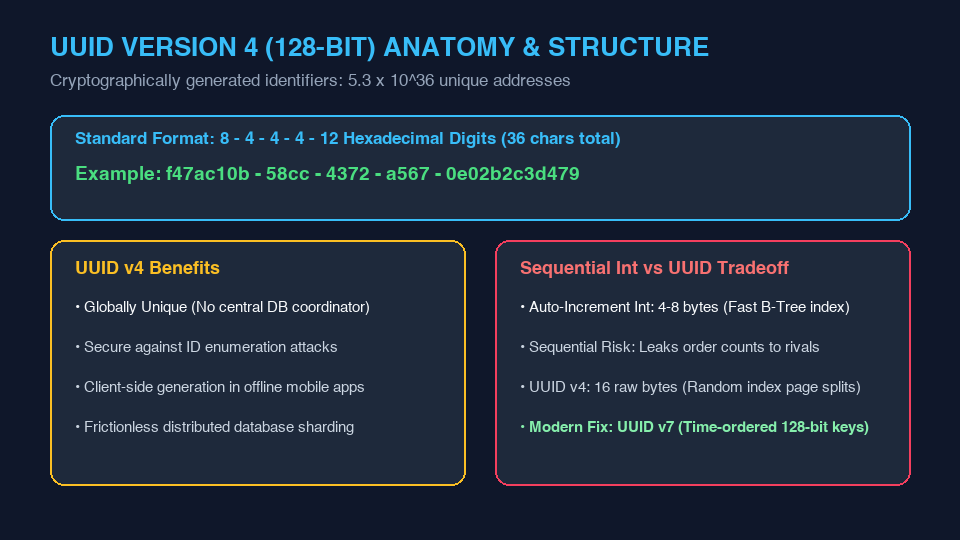
Consider the canonical example:
f47ac10b-58cc-4372-a567-0e02b2c3d479
|---1---| |-2--| |-3--| |-4--| |-----5-----|f47ac10b: 8 hex characters (32 bits)58cc: 4 hex characters (16 bits)4372: 4 hex characters (16 bits) — Notice the leading digit 4, which identifies this as a Version 4 UUID!a567: 4 hex characters (16 bits) — The leading bits define the UUID variant (RFC 4122).0e02b2c3d479: 12 hex characters (48 bits)
Can UUIDs Ever Collide?
A Version 4 UUID relies on 122 bits of cryptographically secure pseudo-random entropy. The total permutation space is 2^122 ≈ 5.3 x 10^36 unique keys. To generate a 50% probability of a single collision, a system would have to generate 1 billion UUIDs per second continuously for 85 years! For all practical software engineering purposes, collisions are mathematically impossible.
2. The Evolution of UUIDs: Version 1 to Version 7
Over decades of software development, several UUID versions have addressed different system needs:
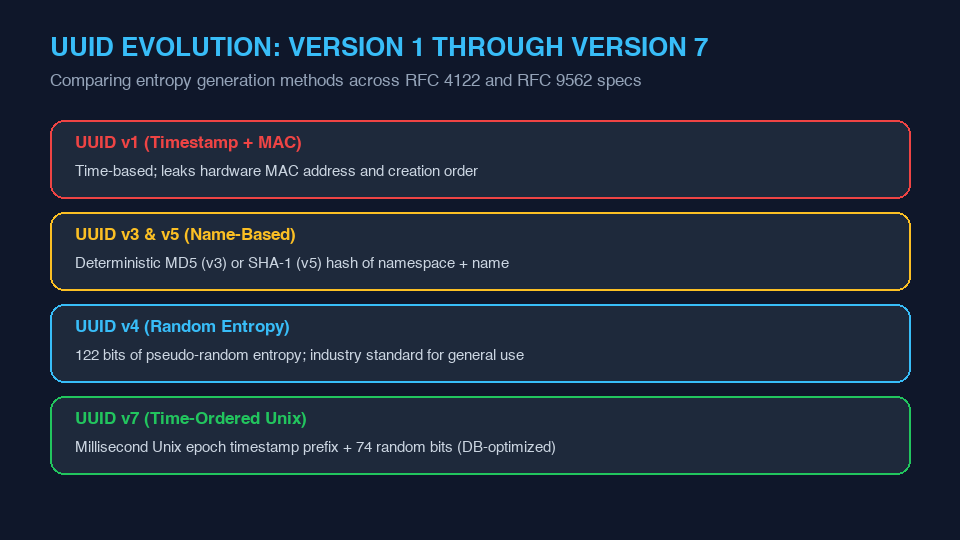
- UUID v1 (Timestamp + MAC Address): Encodes the exact system clock timestamp and network card MAC address. Deprecated for web systems due to hardware tracking privacy concerns.
- UUID v4 (Random Entropy): The dominant industry standard for stateless key generation across distributed microservices.
- UUID v7 (Time-Ordered Epoch - RFC 9562): The cutting-edge modern replacement. UUID v7 combines a 48-bit millisecond Unix timestamp with 74 random bits. Because it is naturally time-ordered, it completely eliminates database B-Tree index fragmentation while retaining global uniqueness!
Generate Cryptographic UUIDs in Your Browser
Need cryptographically random Version 4 UUIDs for your database seeding, API testing, or distributed tracking? Utilize LinkeFly's fast, client-side UUID Generator to generate and batch-export validated UUID keys with zero server tracking.
Frequently Asked Questions (FAQ)
BINARY(16)) and adopting time-sorted UUID v7./order/1042) leak sensitive commercial intelligence to rivals: an attacker can place two orders a week apart and calculate your exact weekly order volume. Furthermore, sequential IDs are vulnerable to Insecure Direct Object Reference (IDOR) attacks where scrapers enumerate every customer record sequentially.