 Deutsch
 العربية
 English
 Español
 Français
 Italiano
 Português
 Русский
 Türkçe
 Tiếng Việt


Programming Casing Conventions: When to Use camelCase, PascalCase, snake_case & kebab-case
The definitive architectural naming standard guide across JavaScript, Python, PHP, CSS, and database engineering.
 By LinkeFly Editorial Team
In computer programming, source code readability is paramount. Because programming language compilers and interpreters prohibit spaces within variable names, function identifiers, and class declarations, developers established systematic typographical conventions to represent multi-word entities.
Adhering to community-standard casing conventions ensures that software projects are maintainable, intuitive for new contributors, and compatible with automated static analysis linters (such as ESLint, PEP 8, and PSR-12).
In this technical master guide, we break down the four dominant casing conventions, chart their applications across major programming languages, and review data transformation pipelines.
1. The Four Core Casing Conventions: Definitions & Rules
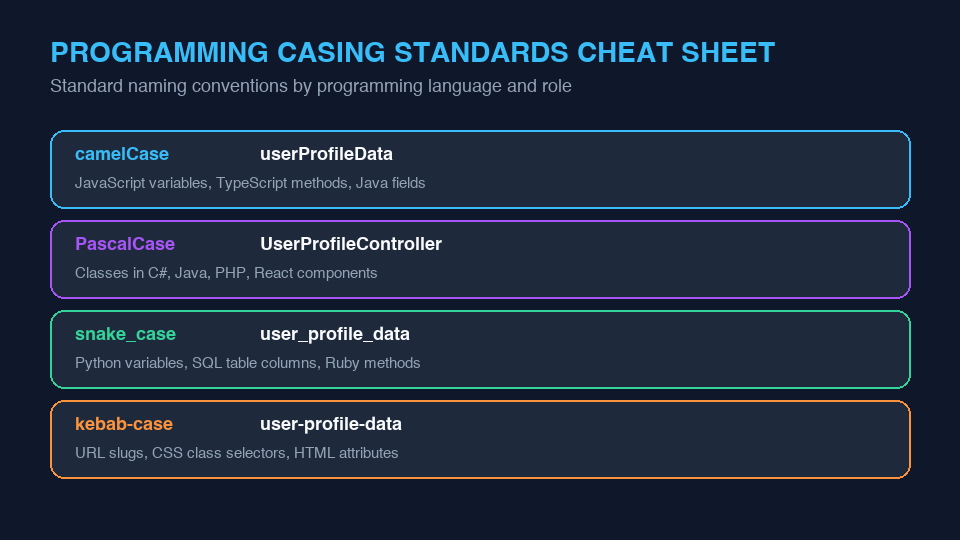
1. camelCase (Lower Camel Case)
The first word begins with a lowercase letter, and every subsequent word starts with an uppercase letter, with zero spaces or separators (e.g., userAccountBalance).
- Standard in: JavaScript, TypeScript, Java, Dart, Swift, Go (unexported identifiers).
- Used For: Variable names, function and method declarations, object property keys.
2. PascalCase (Upper Camel Case)
Every word begins with a capital letter, including the very first word, with zero spaces or separators (e.g., UserAccountController).
- Standard in: C#, TypeScript, Python (class names), PHP, React (JSX components).
- Used For: Classes, interfaces, type aliases, namespaces, and React UI components.
3. snake_case
All letters are lowercase, and individual words are joined by an underscore (_) (e.g., user_account_balance).
- Standard in: Python (PEP 8), Ruby, Rust, SQL databases, C.
- Used For: Python variables and functions, database table and column names, JSON request bodies in REST APIs.
- Variant:
SCREAMING_SNAKE_CASE(all uppercase with underscores) is universally used across all languages for global constants (e.g.,MAX_RETRY_COUNT).
4. kebab-case (Lisp Case / Dash Case)
All letters are lowercase, separated by hyphens (-) (e.g., user-account-balance).
- Standard in: HTML, CSS, URLs, bash scripts, npm package names.
- Used For: CSS class selectors, HTML custom attributes, URL slugs, Docker container names.
2. The Full-Stack Data Transformation Pipeline
In modern full-stack web development, an entity's name constantly transforms as it travels across different architectural layers:
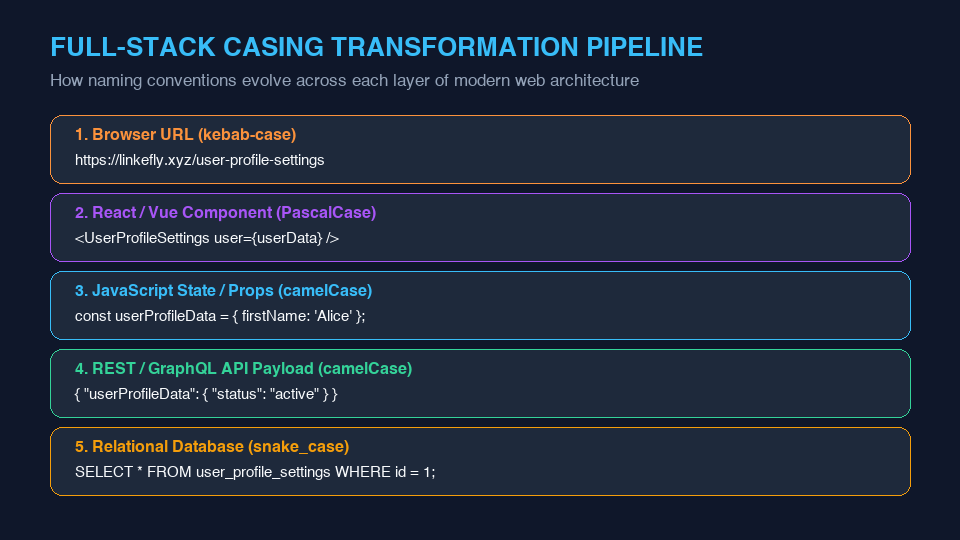
| Architectural Layer | Standard Casing | Concrete Code Example |
|---|---|---|
| Browser URL | kebab-case |
https://linkefly.xyz/user-profile-settings |
| React Component | PascalCase |
<UserProfileSettings user={userData} /> |
| Frontend State | camelCase |
const userProfileData = { firstName: 'Alice' }; |
| REST API Payload | camelCase |
{ "userProfileData": { "status": "active" } } |
| Relational Database | snake_case |
SELECT * FROM user_profile_settings WHERE id = 1; |
Transform Casing Instantly with LinkeFly
Switch effortlessly between camelCase, PascalCase, snake_case, UPPERCASE, and title case with our free tool:
Open LinkeFly Case Converter →3. Frequently Asked Questions (FAQ)
snake_case for functions and variables to promote readability, reserving PascalCase exclusively for class declarations.-) is the arithmetic subtraction operator. Writing let user-name = 5; is parsed as let user - name = 5;, resulting in a syntax error.snake_case columns into JavaScript camelCase object properties automatically.Conclusion
Software naming conventions are the silent foundation of team productivity. By respecting language-specific conventions and keeping naming consistent across codebases, you eliminate friction and ensure code remains readable for years to come.