 Deutsch
 العربية
 English
 Español
 Français
 Italiano
 Português
 Русский
 Türkçe
 Tiếng Việt


TDEE and Calorie Deficit Math: The Evidence-Based Guide to Energy Expenditure and Nutrition
Demystifying BMR, NEAT, TEF, the Mifflin-St Jeor formula, and sustainable fat loss.
 By LinkeFly Editorial Team
In an industry saturated with fads, detoxes, and conflicting dietary dogmas, human body composition remains strictly governed by an immutable law of physics: the First Law of Thermodynamics. Energy cannot be created or destroyed; it can only change form. In human biology, changes in stored body mass (fat and muscle) are dictated by energy balance: calories consumed versus calories expended.
Yet, millions of individuals fail to achieve their fitness and weight management goals because they base their nutritional intake on generic 2,000-calorie labels. True energy balance requires calculating your personal Total Daily Energy Expenditure (TDEE). In this scientific guide, we dissect the four biological components of daily calorie burn, review validated metabolic formulas, and explain how to structure a sustainable calorie deficit.
1. The Four Pillars of Total Daily Energy Expenditure (TDEE)
Your TDEE is the total cumulative sum of all calories your body burns across a 24-hour period. It comprises four distinct metabolic components:
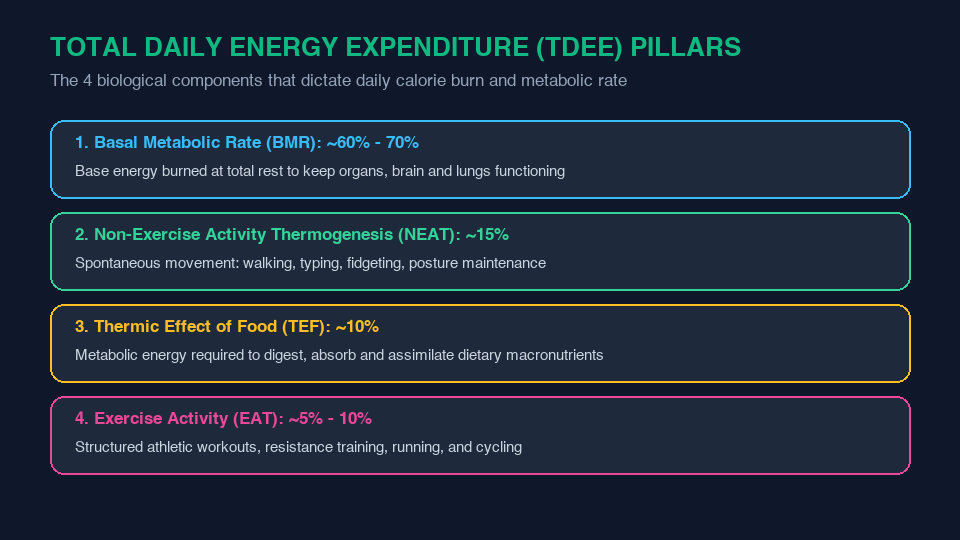
A. Basal Metabolic Rate (BMR): ~60% to 70%
The energy required to keep your vital physiological organs (brain, heart, liver, kidneys, lungs) alive at complete physical and digestive rest. Even if you remained motionless in bed for 24 hours, your BMR would account for the majority of your daily calorie expenditure.
B. Non-Exercise Activity Thermogenesis (NEAT): ~15%
The energy expended for everything that is not sleeping, eating, or sports-like exercise: walking, standing, typing, household chores, and subconscious posture adjustments. NEAT is the single largest variable between sedentary individuals and active individuals, varying by up to 800+ calories daily!
C. Thermic Effect of Food (TEF): ~10%
The metabolic cost of digesting, absorbing, and assimilating nutrients from food:
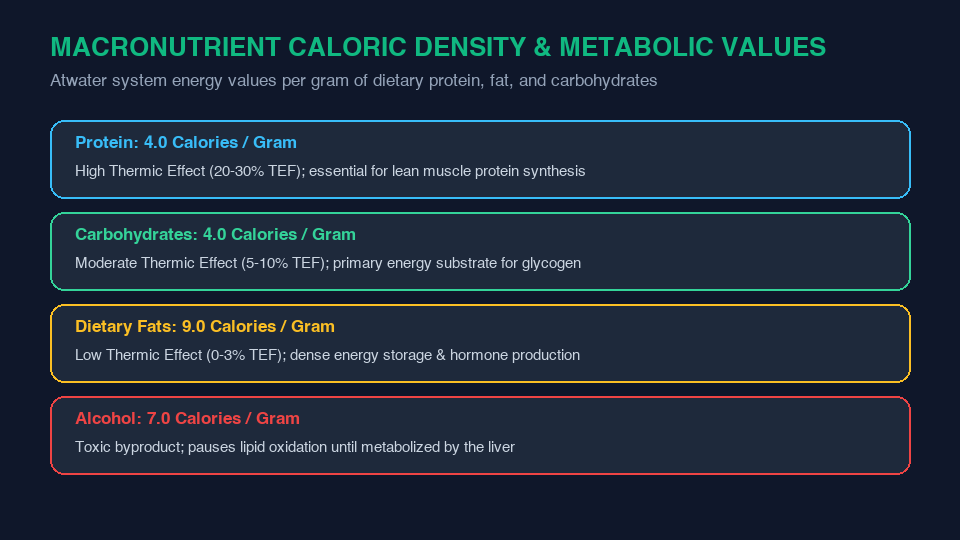
- Dietary Protein: Has the highest TEF at 20% – 30% (your body burns nearly a third of protein calories simply digesting it!).
- Carbohydrates: Moderate TEF at 5% – 10%.
- Dietary Fats: Lowest TEF at 0% – 3%.
D. Exercise Activity Thermogenesis (EAT): ~5% to 10%
Structured athletic training, weight lifting, cycling, and running. Counterintuitively, structured gym sessions contribute the smallest overall fraction of daily calorie expenditure compared to BMR and NEAT.
2. Calculating Your BMR: The Mifflin-St Jeor Formula
While lab testing via indirect calorimetry is the gold standard, clinical research published in the American Journal of Clinical Nutrition confirms the Mifflin-St Jeor equation is the most accurate predictive formula for healthy adults:
- For Men:
BMR = (10 x weight in kg) + (6.25 x height in cm) - (5 x age in years) + 5 - For Women:
BMR = (10 x weight in kg) + (6.25 x height in cm) - (5 x age in years) - 161
To compute TDEE, multiply BMR by an appropriate physical activity factor (ranging from 1.2 for sedentary desk workers up to 1.725 for heavily active athletes).
3. Structuring a Sustainable Calorie Deficit
One pound of human adipose tissue roughly equals 3,500 calories of stored biochemical energy. To achieve healthy, sustainable fat loss while preserving metabolically active lean muscle:
- Moderate Deficit (Recommended): Consume 300 to 500 calories below your TDEE daily. This targets approximately 0.5 to 1.0 pound of fat loss per week without triggering severe metabolic adaptation, lethargy, or binge urges.
- High Protein Intake: Consume 0.7 to 1.0 grams of protein per pound of body weight to maximize muscle protein synthesis and promote satiety.
Calculate Your TDEE and Target Calories
Ready to discover your exact daily calorie maintenance and fat loss targets? Utilize LinkeFly's comprehensive TDEE Calculator and Calorie Calculator to calculate your personalized metabolic profile in seconds.