English
 العربية
 Deutsch
 Español
 Français
 Italiano
 Português
 Русский
 Türkçe
 Tiếng Việt


Understanding IP Addresses: The Architectural Guide to IPv4, IPv6, Subnetting, and Geolocation
From 32-bit dotted-decimal exhaustion to 128-bit global unicast networking and privacy implications.
 By LinkeFly Editorial Team
Every digital packet traversing the global internet—from streaming 4K video to executing a microsecond database query—relies on a fundamental numerical identifier: the Internet Protocol (IP) Address. Functioning as the postal system of the digital age, IP addresses govern how routers forward datagrams across heterogeneous networks spanning millions of physical machines.
Yet, as the global connected device count surpasses 30 billion, the internet's foundational addressing architecture is undergoing its largest structural transition since the 1980s: migrating from the exhausted 32-bit IPv4 pool to the virtually limitless 128-bit IPv6 universe. In this guide, we break down IP routing, CIDR subnetting, NAT traversal, and geolocation intelligence.
1. The Anatomy of an IP Address: IPv4 vs IPv6
An IP address is an immutable layer-3 (Network Layer) label within the OSI reference model that accomplishes two primary objectives: identifying the host network interface and providing host location addressing.
A. IPv4: The 32-Bit Foundation
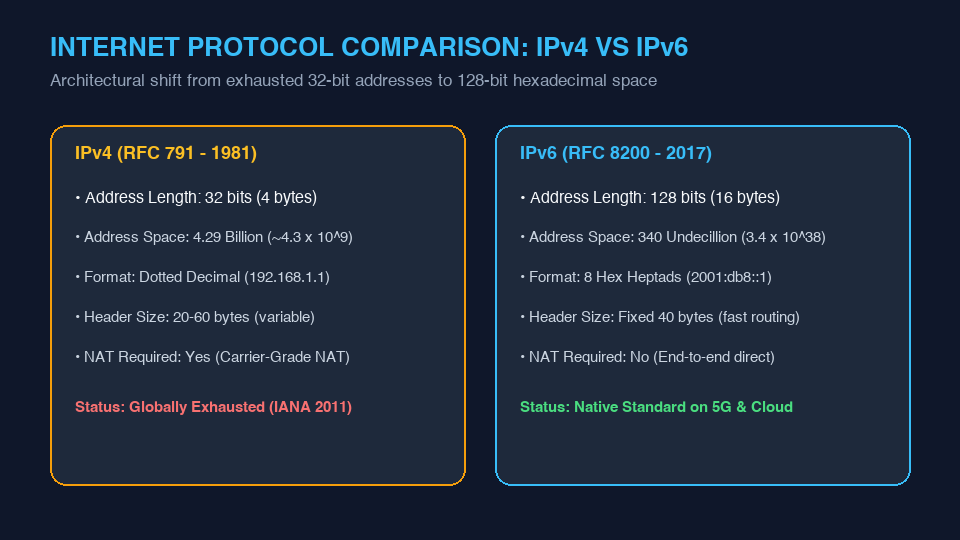
Standardized in 1981 by RFC 791, IPv4 addresses consist of 32 bits divided into four 8-bit octets separated by periods (e.g. 192.168.1.1). With 32 binary bits, the maximum theoretical pool is:
2^32 = 4,294,967,296 unique addresses
Because millions of addresses were reserved for loopback (127.0.0.0/8), private intranets (RFC 1918), and multicast groups, the usable public pool was formally exhausted by IANA in February 2011.
B. IPv6: The 128-Bit Horizon
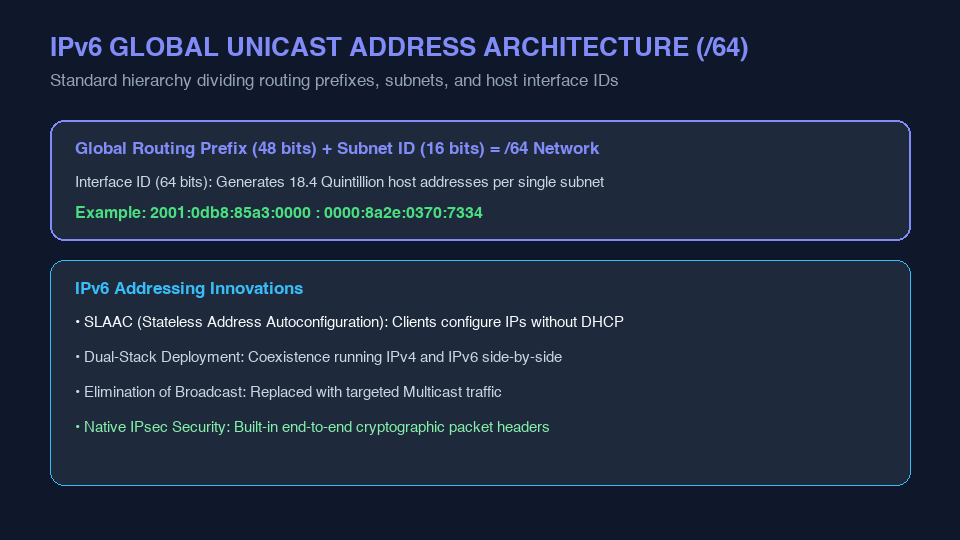
To eliminate address scarcity permanently, RFC 8200 established IPv6, utilizing 128 bits represented as eight groups of four hexadecimal digits separated by colons (e.g. 2001:0db8:85a3:0000:0000:8a2e:0370:7334). This provides:
2^128 = 3.4028 x 10^38 unique addresses (340 Undecillion)
This astronomical number provides enough unique IP addresses to assign billions of individual IPs to every atom on the surface of the planet.
2. Public vs Private Addresses and NAT Traversal
To prolong the operational life of IPv4, network engineers devised Network Address Translation (NAT). Under NAT, millions of devices share a single public IP address assigned by an Internet Service Provider (ISP):
- Private IP Ranges (RFC 1918): Addresses reserved exclusively for internal local area networks (LANs). Common blocks include
10.0.0.0/8,172.16.0.0/12, and192.168.0.0/16. These packets are strictly dropped by public internet backbone routers. - Public IP Address: The globally routable address assigned to your WAN interface or gateway router. External web servers (such as Google or LinkeFly) only see this public address.
3. Geolocation and IP Lookup Intelligence
While an IP address does not expose physical GPS coordinates or home addresses, it maps deterministically to an ISP, Autonomous System Number (ASN), country, region, and metropolitan area. IP geolocation databases (such as MaxMind and IP2Location) correlate network routing announcements (BGP tables) to infer location for:
- Fraud prevention and payment risk scoring
- Localized content delivery and international currency display
- Content delivery network (CDN) edge routing to minimize latency
- Regulatory compliance and regional licensing restrictions
Discover Your Public IP Instantly
Curious what public address, ISP, and geographic origin your browser presents to web servers? Check out the free LinkeFly What Is My IP Tool and inspect remote servers with our comprehensive IP Address Lookup Tool.
Frequently Asked Questions (FAQ)
/24 prefix indicates that the first 24 bits represent the network ID, leaving the remaining 8 bits to allocate up to 256 host addresses (254 usable) within that local subnet.