English
 العربية
 Deutsch
 Español
 Français
 Italiano
 Português
 Русский
 Türkçe
 Tiếng Việt


Sales Tax and GST Calculation: The Comprehensive Financial Guide to Inclusive vs Exclusive Pricing
Mastering VAT, GST, input tax credits, reverse tax extraction, and automated invoice math.
 By LinkeFly Editorial Team
Across the global economy, indirect consumption taxes—known variously as Goods and Services Tax (GST), Value-Added Tax (VAT), or Sales Tax—are the lifeblood of state revenues. For e-commerce store operators, freelance service providers, and business accountants, calculating these taxes correctly is essential to avoid regulatory fines and prevent pricing margin bleed.
Yet, a pervasive source of bookkeeping errors stems from confusing tax-exclusive pricing (adding tax to a net figure) with tax-inclusive pricing (reversing or extracting tax already embedded within a gross sticker price). In this financial guide, we break down both mathematical formulas, explain the mechanics of Input Tax Credits (ITC), and share invoice auditing best practices.
1. Tax Exclusive vs Tax Inclusive Formulas
Understanding which calculation to apply depends on whether the stated price already contains the statutory tax liability:
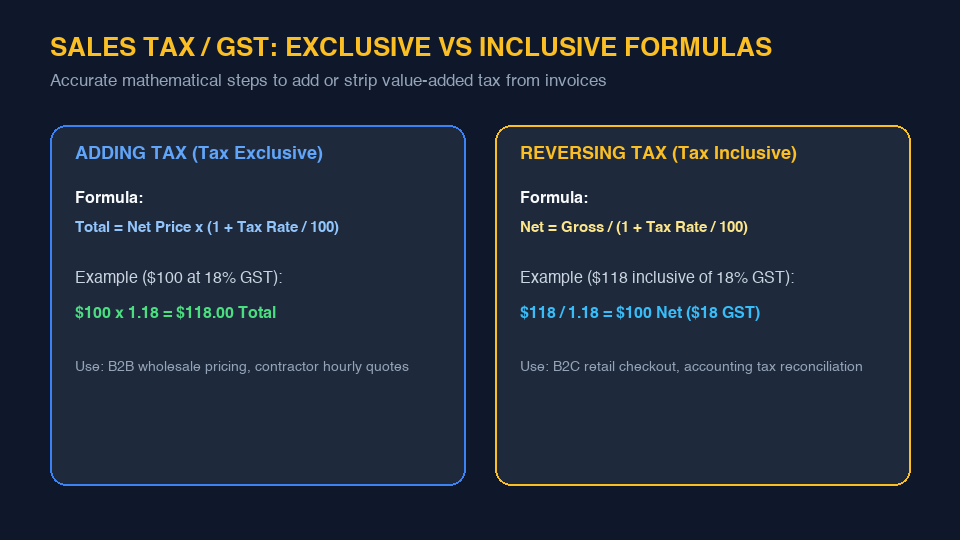
A. Adding Tax (Tax Exclusive Pricing)
Used predominantly in B2B transactions and US retail checkouts where shelf prices are listed without tax. To calculate the final gross invoice total:
Tax Amount = Net Price x (Tax Rate / 100)
Gross Total = Net Price + Tax Amount = Net Price x (1 + (Tax Rate / 100))
For example, if your net service fee is $500 and the applicable GST rate is 18%:
Tax = $500 x 0.18 = $90.00 | Gross Total = $590.00
B. Reversing Tax (Tax Inclusive Pricing)
Used extensively in European VAT and Indian retail (B2C) where shelf prices are legally required to display the all-inclusive consumer price. The most common amateur mistake is multiplying the gross price by the tax rate (e.g. $118 x 0.18 = $21.24, which is mathematically incorrect!). The true formula requires dividing by the tax factor:
Net Price = Gross Total / (1 + (Tax Rate / 100))
Tax Amount = Gross Total - Net Price
For an item priced at $118.00 inclusive of 18% tax:
Net Price = $118.00 / 1.18 = $100.00 | Actual Tax = $18.00
2. How the Input Tax Credit (ITC) Eliminates Cascading Taxes
The primary innovation of modern GST/VAT systems over archaic turnover taxes is the elimination of the cascading effect (tax on tax). Businesses along the supply chain only pay tax on the value they personally add:
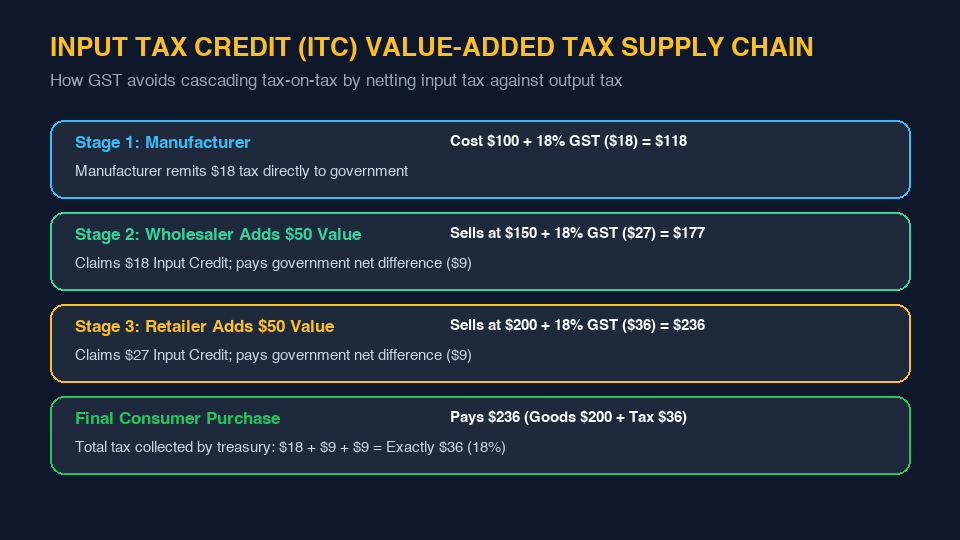
- When a registered wholesaler purchases raw inventory, the GST paid to the manufacturer is recorded as an Input Tax Credit.
- When the wholesaler sells to a retailer, they collect output tax from the buyer.
- The wholesaler remits only the net difference (
Output Tax - Input Credit) to the government treasury, ensuring tax is never levied twice on the same underlying cost base.
Calculate GST and Sales Tax in Real Time
Avoid invoice calculation blunders. Use LinkeFly's fast, client-side GST Calculator and Sales Tax Calculator to add or reverse tax percentages effortlessly with full itemized breakdowns.
Frequently Asked Questions (FAQ)
(1 + rate) to isolate the true base.