 العربية
 Deutsch
 English
 Español
 Français
 Italiano
 Português
 Русский
 Türkçe
 Tiếng Việt


Metric vs Imperial Measurement Systems: The Engineering and Science Conversion Guide
From the French revolution meter to the 1959 international yard and aerospace unit disasters.
 By LinkeFly Editorial Team
Measurement is the common language of global commerce, civil engineering, and aerospace exploration. Yet humanity remains divided between two competing paradigms: the internationally harmonized Metric System (International System of Units - SI) used by over 95% of the world's population, and the legacy Imperial / US Customary System prevalent in the United States and specialized industries.
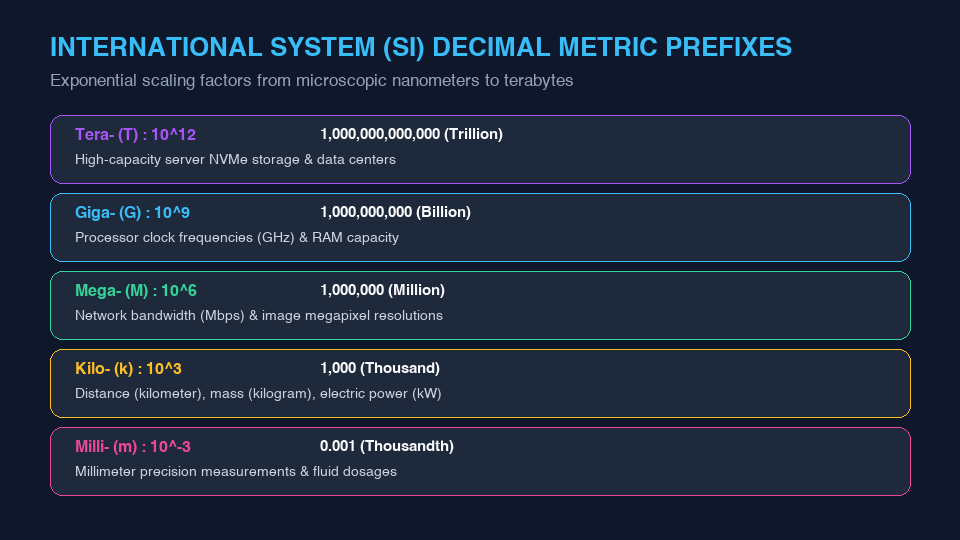
Failing to navigate unit conversions with mathematical precision has led to catastrophic engineering failures, including the famous loss of NASA's $125 million Mars Climate Orbiter in 1999 due to an uncoordinated software handoff between pound-seconds and newton-seconds. In this guide, we review the scientific history of measurement, examine exact international conversion constants, and explore SI decimal prefix scaling.
1. The Scientific Foundations: Base-10 Simplicity vs Base-12 History
The two systems reflect fundamentally different historical and philosophical origins:
A. The Metric System (SI)
Born during the French Revolution in the 1790s, the metric system was intentionally designed from universal physical constants. Today, all seven base SI units (meter, kilogram, second, ampere, kelvin, mole, candela) are anchored directly to fundamental invariants of the universe (such as the speed of light and the Planck constant). Crucially, the metric system scales exclusively by powers of ten (base-10), making mental math and engineering calculations as effortless as shifting decimal points.
B. The Imperial and US Customary Systems
Evolving organically from ancient Roman, Anglo-Saxon, and medieval trading customs, Imperial units were originally based on human anatomy: an inch was roughly the width of a thumb, a foot was the length of a human foot, and an acre was the area a team of oxen could plow in a single day. While intuitive for agrarian daily life, the fractional relationships (12 inches to a foot, 3 feet to a yard, 1,760 yards to a mile, 16 ounces to a pound) introduce high computational friction in modern scientific analysis.
2. International Standard Conversion Constants
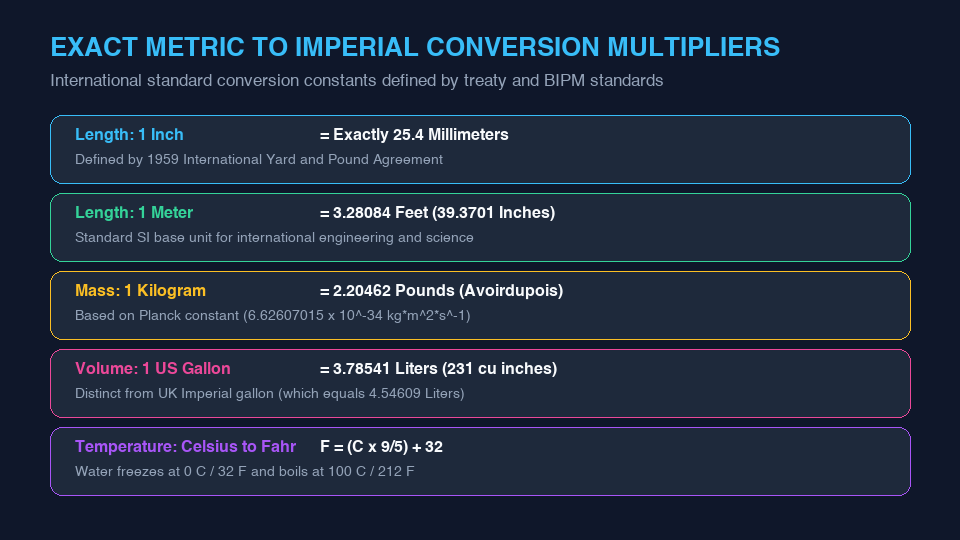
To eliminate transatlantic trade discrepancies, the governments of the United States, United Kingdom, Canada, Australia, and New Zealand signed the landmark 1959 International Yard and Pound Agreement, formally defining all Imperial units strictly in terms of metric equivalents:
- 1 International Inch: Defined as exactly 25.4 millimeters.
- 1 International Pound (Avoirdupois): Defined as exactly 0.45359237 kilograms.
- 1 Meter: Equals approximately 3.28084 feet or 39.3701 inches.
- 1 Kilogram: Equals approximately 2.20462 pounds.
Convert Length and Weight Instantly
Need to rapidly convert inches to centimeters, feet to meters, or pounds to kilograms without calculating decimal multipliers? Try LinkeFly's fast, client-side Length Converter and Weight Converter for instant high-precision conversions.
Frequently Asked Questions (FAQ)
°F = (°C x 9/5) + 32 and °C = (°F - 32) x 5/9.