 العربية
 Deutsch
 English
 Español
 Français
 Italiano
 Português
 Русский
 Türkçe
 Tiếng Việt


E-Commerce Payment Gateway Fees: How to Calculate, Reverse-Price, and Reduce Stripe & PayPal Costs
Protect your net operating margins with exact transaction cost modeling, cross-border analysis, and micro-transaction strategies.
 By LinkeFly Editorial Team
For e-commerce founders, digital product creators, and SaaS operators, merchant processing fees represent one of the most substantial variable operating expenses on the balance sheet. In an industry where net profit margins often hover between 10% and 25%, paying an unoptimized 3% to 6% in payment gateway fees directly erodes bottom-line profitability.
Most business owners only look at the headline rate: "2.9% + $0.30". They fail to understand how the fixed per-transaction fee severely punishes lower Average Order Values (AOVs), or how cross-border conversion markups compound silently.
In this technical and financial master guide, we deconstruct payment processing cost structures, provide the exact mathematical reverse-pricing formulas, and evaluate actionable strategies for minimizing gateway deductions.
1. The Anatomy of Payment Gateway Pricing Models
Most modern payment processing aggregators (Stripe, PayPal, Square, Shopify Payments) operate on a blended interchange pricing model:
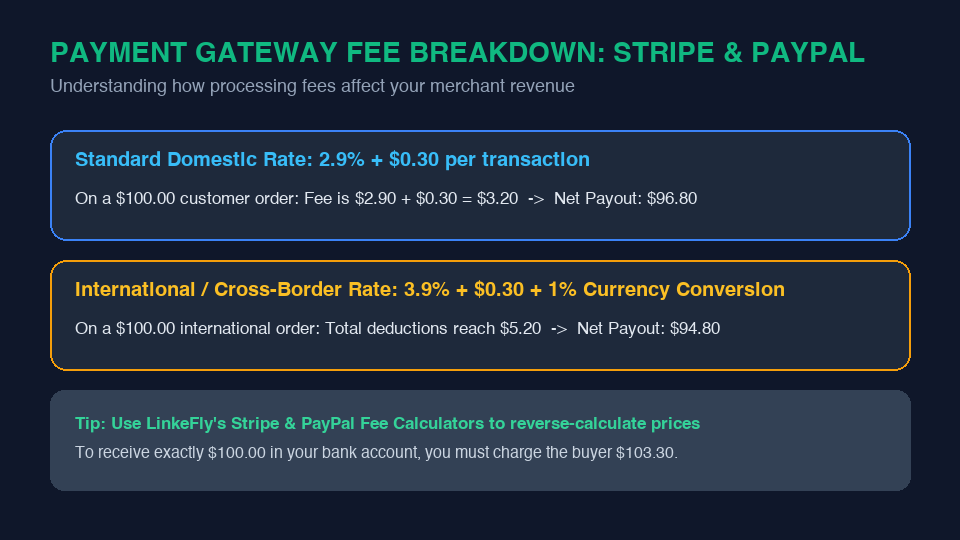
The Three Core Fee Components:
- Variable Percentage Fee (Typically 2.9%): Covers credit card interchange fees paid to card-issuing banks (Visa, Mastercard, Amex) and card network assessments.
- Fixed Transaction Surcharge (Typically $0.30): A flat charge levied on every successful transaction attempt, regardless of the sale volume.
- International & Currency Conversion Add-Ons (+1.0% to +1.5%): Levied whenever a customer uses a card issued outside your domestic country, or when paying in a foreign currency.
2. The Micro-Transaction Trap: Fixed Fee Drag on Profit Margins
The flat $0.30 surcharge creates an aggressive mathematical drag on low-ticket orders. Consider the true effective fee percentage across varying transaction sizes:
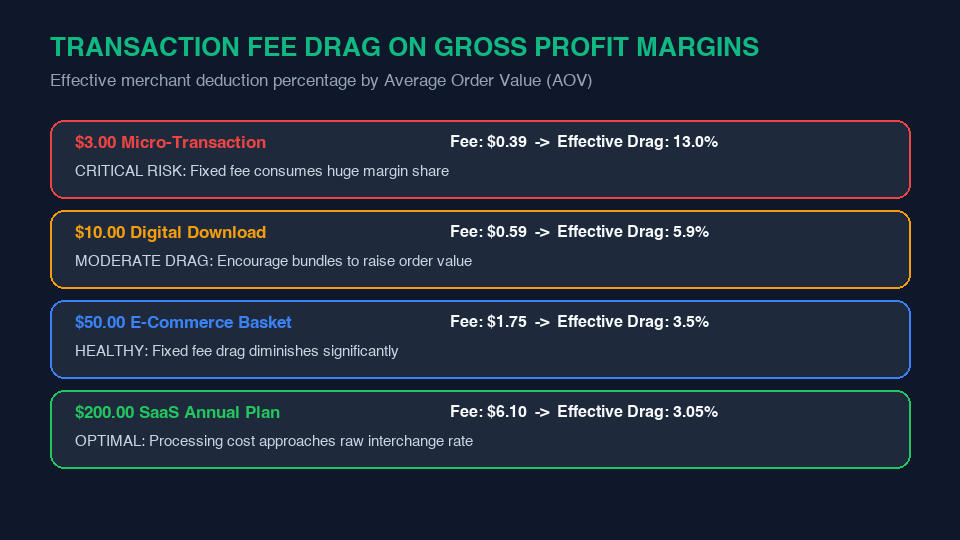
| Order Amount | Percentage Fee (2.9%) | Fixed Fee ($0.30) | Total Gateway Deduction | Effective Fee % |
|---|---|---|---|---|
| $3.00 | $0.09 | $0.30 | $0.39 | 13.0% |
| $10.00 | $0.29 | $0.30 | $0.59 | 5.9% |
| $50.00 | $1.45 | $0.30 | $1.75 | 3.5% |
| $200.00 | $5.80 | $0.30 | $6.10 | 3.05% |
3. The Reverse-Pricing Mathematical Formula
If you want to receive exactly $100.00 net in your business bank account, you cannot simply charge $103.20. If you charge $103.20, the gateway deducts 2.9% of the new total ($2.99) plus $0.30, leaving you with only $99.91!
To calculate the exact amount to bill the customer, use the algebraic reverse pricing formula:
Gross Charge Amount = (Target Net Payout + Fixed Fee) / (1 - Percentage Fee Rate)

Example Calculation (Target $100.00 net at 2.9% + $0.30):
Gross Charge = ($100.00 + $0.30) / (1 - 0.029)
Gross Charge = $100.30 / 0.971
Gross Charge = $103.30
When you charge $103.30: the 2.9% fee is $3.00, plus $0.30 fixed fee equals $3.30 total deductions, leaving you with precisely $100.00 net payout.
Calculate Gateway Fees Instantly with LinkeFly
Determine exact processing fees and reverse-calculate invoice totals in seconds with our dedicated merchant calculators:
4. Frequently Asked Questions (FAQ)
Conclusion
Payment processing fees are an unavoidable cost of digital commerce, but they should never be a mystery. By understanding the underlying fee mechanics and applying reverse-pricing formulas, you insulate your business from margin compression and maximize net revenue.