 العربية
 Deutsch
 English
 Español
 Français
 Italiano
 Português
 Русский
 Türkçe
 Tiếng Việt


Data Serialization and Migrations: Converting Between CSV, XML, and JSON in Modern Architectures
Benchmarking data interchange formats, structural tree hierarchies, and schema validation.
 By LinkeFly Editorial Team
In an interconnected world of cloud microservices, relational databases, third-party SaaS integrations, and data lakes, software systems rarely speak a single native format. Backend engineers constantly migrate datasets between three dominant serialization standards: tabular CSV, deeply nested XML, and the modern web's lingua franca, JSON.
Choosing the wrong serialization format can lead to excessive network payload bloat, CPU-intensive parsing bottlenecks, or silent data corruption when nested hierarchies are flattened. In this technical guide, we benchmark all three data formats, explore structural tree-to-table mappings, and examine schema validation best practices.
1. Format Benchmarks: CSV vs XML vs JSON
Each format was created to address distinct architectural constraints of its era:
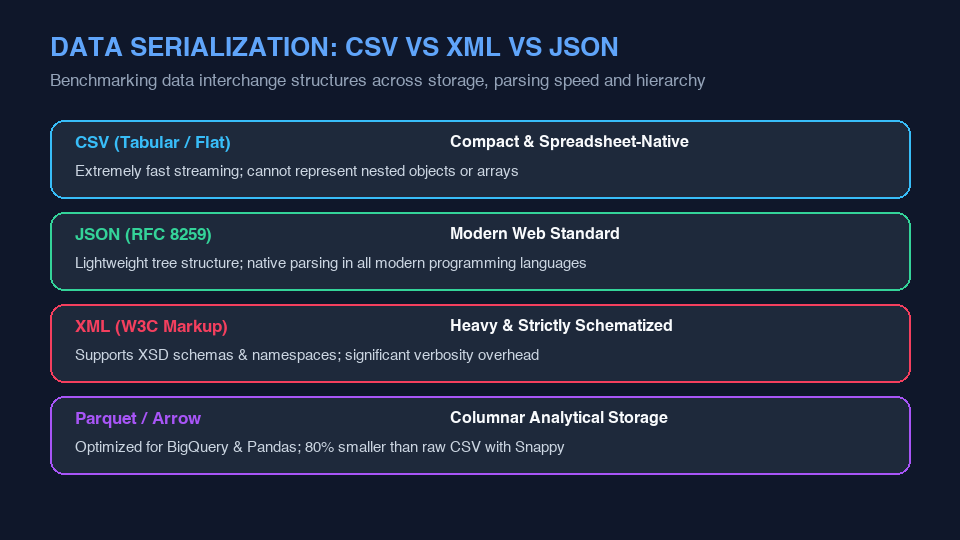
A. Comma-Separated Values (CSV)
CSV is the simplest and most compact format for flat, tabular records. By omitting repetitive field keys on every single row, CSV achieves 50% to 70% smaller payloads than raw JSON. However, CSV has no native mechanism to represent nested child objects, arrays, or strict data types (numbers, booleans, and dates are all stored as raw text strings).
B. JavaScript Object Notation (JSON - RFC 8259)
JSON is the universal standard for modern RESTful APIs and NoSQL document stores (such as MongoDB). It provides a lightweight, human-readable tree hierarchy supporting native booleans, numbers, strings, nulls, and nested arrays. Browsers parse JSON natively via hardware-accelerated JSON.parse() with virtually zero overhead.
C. Extensible Markup Language (XML)
XML remains dominant in enterprise banking (SOAP protocols), healthcare (HL7), and Android app layouts. While notorious for verbose opening and closing tags that bloat network payloads, XML provides enterprise-grade schema validation (XSD), namespaces, and XPath querying.
2. Enforcing Data Contracts with JSON Schema
To prevent malformed payloads from crashing downstream microservices during data ingestion, modern engineering teams enforce strict JSON Schema validation:
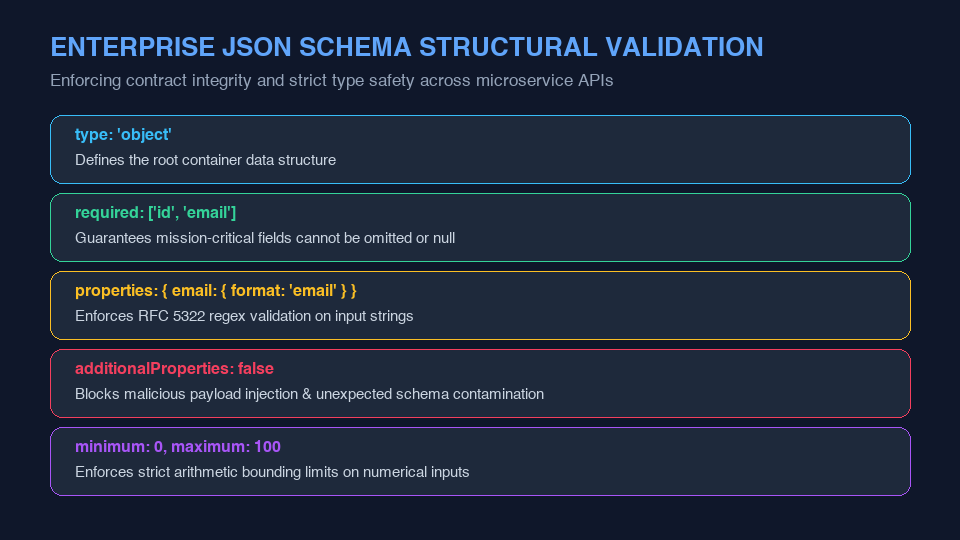
{
  "$schema": "https://json-schema.org/draft/2020-12/schema",
  "type": "object",
  "properties": {
    "userId": { "type": "integer", "minimum": 1 },
    "email": { "type": "string", "format": "email" },
    "isActive": { "type": "boolean" }
  },
  "required": ["userId", "email"],
  "additionalProperties": false
}
Convert Data Formats in Real Time
Need to convert legacy XML files into clean JSON, transform CSV spreadsheets into API objects, or generate XML from JSON payloads? Utilize LinkeFly's comprehensive suite of client-side converters: CSV to JSON, XML to JSON, and JSON to XML completely free.
Frequently Asked Questions (FAQ)
user.address.city) or stringifying nested arrays with internal delimiters (e.g. tag1|tag2|tag3) enclosed in double quotes.