 العربية
 Deutsch
 English
 Español
 Français
 Italiano
 Português
 Русский
 Türkçe
 Tiếng Việt


Binary Code Demystified: The Computational Guide to Bits, Bytes, ASCII, and Bitwise Logic
How microscopic transistors translate binary ones and zeros into modern software and text.
 By LinkeFly Editorial Team
Beneath every high-level programming language, sleek graphical user interface, and artificial intelligence model lies a mesmerizingly simple physical reality: billions of microscopic silicon transistors switching between two electrical voltage states—high voltage (1) and low voltage (0). This base-2 numerical system, known as Binary Code, is the universal language of digital computing.
Understanding how raw electrical voltage transitions translate into arithmetic integers, text characters, cryptographic ciphers, and network packets is essential knowledge for software engineers, cybersecurity specialists, and computer scientists. In this foundational guide, we unpack positional base-2 notation, dissect 8-bit byte registers, trace ASCII character encoding, and demonstrate low-level bitwise operations.
1. Positional Number Systems: Base-10 vs Base-2
In everyday human life, we rely on the decimal system (base-10), primarily because human ancestors counted on ten fingers. In base-10, each digit column represents an increasing power of ten: 10^0 (units), 10^1 (tens), 10^2 (hundreds), 10^3 (thousands).
Computers, however, operate in the binary system (base-2), where each digit column represents an increasing power of two:
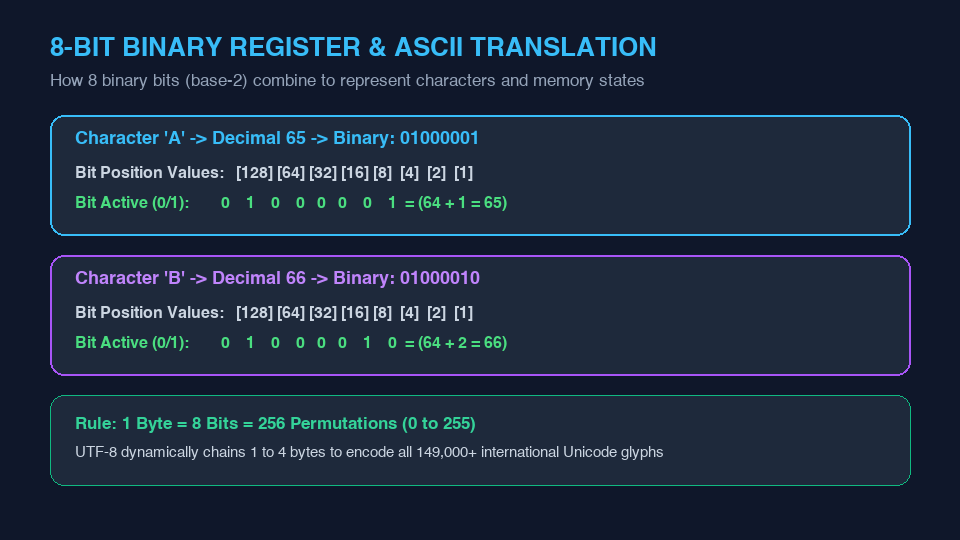
In an 8-bit byte, the bit positions carry values of 128, 64, 32, 16, 8, 4, 2, and 1. To calculate the decimal value of the byte 01000001, we sum only the active bit columns:
(0 x 128) + (1 x 64) + (0 x 32) + (0 x 16) + (0 x 8) + (0 x 4) + (0 x 2) + (1 x 1) = 64 + 1 = 65
2. Translating Numbers into Text: The ASCII and Unicode Standard
Numbers are useful for math, but humans interact through written language. In 1963, the American Standards Association created the American Standard Code for Information Interchange (ASCII) to standardize how binary numbers map to typographical glyphs.
- ASCII assigns decimal
65(binary01000001) to uppercase letter'A'. - ASCII assigns decimal
66(binary01000010) to uppercase letter'B'. - ASCII assigns decimal
97(binary01100001) to lowercase letter'a'. Notice that toggling the 6th bit (32) seamlessly converts between uppercase and lowercase letters!
Standard 7-bit ASCII only accommodated 128 characters—sufficient for English, but incapable of representing Chinese ideograms, Arabic script, or emojis. Modern software uses UTF-8, a variable-length encoding that maps up to 4 bytes to represent over 149,000 international characters.
3. High-Speed Bitwise Logic: AND, OR, XOR, and Bit Shifts
Modern microprocessors execute bitwise logic operations in a single clock cycle, making bitwise manipulation the foundation of ultra-fast graphics rendering, cryptographic algorithms, and embedded systems:
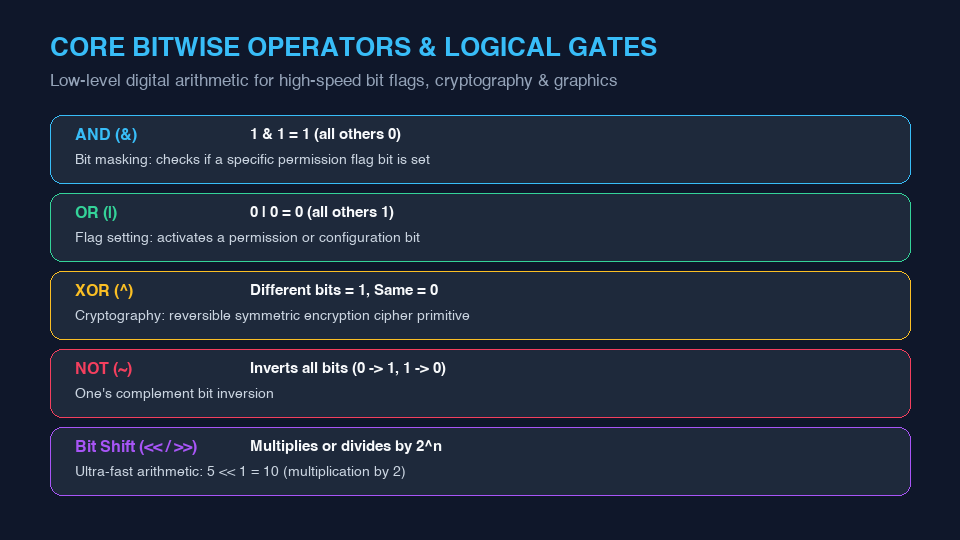
- Bitwise AND (
&): Used for bit-masking to verify whether specific permission flags are enabled. - Bitwise OR (
|): Used to set specific configuration bits without altering other register flags. - Bitwise XOR (
^): Returns 1 if bits differ. Used extensively in symmetric stream ciphers (such as AES) and hash functions. - Bit Shifting (
<</>>): Shifting binary bits left multiplies by powers of two; shifting right divides by powers of two with zero floating-point overhead.
Convert Text to Binary Effortlessly
Need to convert text messages into raw 8-bit binary strings, or decode machine binary code back into human-readable ASCII text? Utilize the fast, client-side LinkeFly Text to Binary Tool and Binary to Text Tool completely free.
Frequently Asked Questions (FAQ)
11111111 is simply FF in hex).