Tiếng Việt
 العربية
 Deutsch
 English
 Español
 Français
 Italiano
 Português
 Русский
 Türkçe


Loan Amortization Dynamics: How APR, Compound Interest, and Extra Principal Slash Debt
Unveiling the mathematics of front-loaded interest, debt avalanche vs snowball, and saving tens of thousands.
 By LinkeFly Editorial Team
Whether taking out a 30-year residential mortgage, financing an automobile, or borrowing business working capital, personal debt is among the largest financial obligations consumers and companies encounter. Yet, the vast majority of borrowers look exclusively at one number: the monthly payment, remaining oblivious to the underlying mechanics of loan amortization.
Because fixed-rate installment loans front-load interest charges, borrowers frequently spend the first 5 to 10 years paying predominantly financing charges with minimal principal equity reduction. In this comprehensive guide, we dissect amortization schedules, compare APR vs interest rate, and demonstrate how small additional principal payments can save over $50,000 and cut years off your debt.
1. What is an Amortization Schedule?
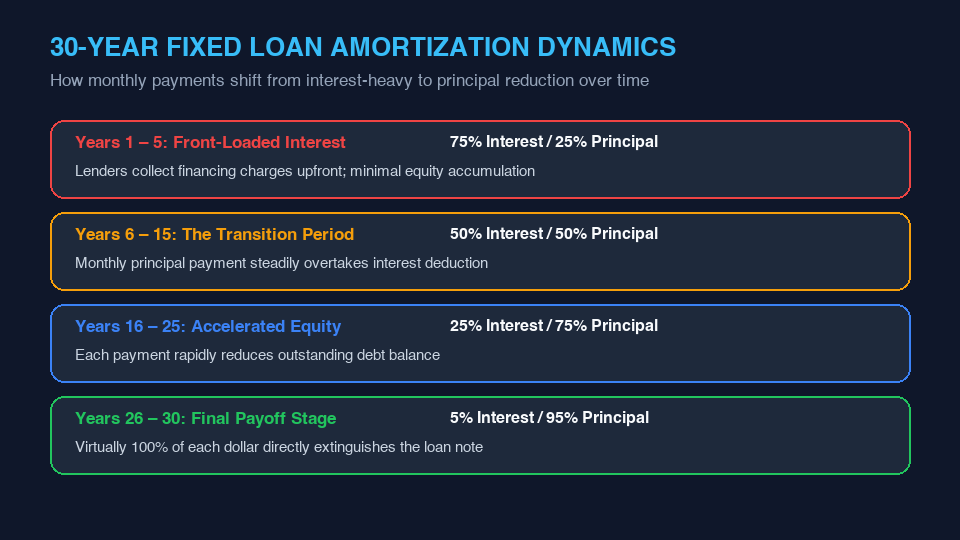
Amortization is the process of spreading a loan into a series of equal, periodic installment payments over a predefined term. While the total monthly dollar amount remains identical every month, the internal allocation between principal and interest changes dramatically over time:
Why is Interest Front-Loaded?
Lenders calculate interest every month based on the current outstanding loan balance. In the first year of a $300,000 mortgage at 6.5%, the balance is at its absolute maximum ($300k). Consequently, monthly interest charges exceed $1,600, leaving only ~$250 of each $1,896 payment to reduce actual debt principal. As the principal balance slowly diminishes over decades, monthly interest drops, allowing an increasing share of every payment to extinguish the debt.
2. APR vs Nominal Interest Rate: What Are You Really Paying?
Lenders frequently market a low "interest rate" in bold type, accompanied by a higher Annual Percentage Rate (APR) in fine print:
- Nominal Interest Rate: The pure percentage charged by the bank on the borrowed principal balance.
- APR: The comprehensive effective annual cost of borrowing, which incorporates the nominal interest rate plus mandatory financing fees, closing origination fees, appraisal charges, and discount points amortized over the loan term.
When shopping between competing lenders, always compare the APR rather than the nominal interest rate to evaluate true out-of-pocket borrowing costs.
3. The Exponential Power of Extra Principal Payments
Because interest is calculated strictly on remaining principal balance, every extra dollar paid directly toward principal permanently eliminates all future compound interest that dollar would have accrued over the remaining loan term:
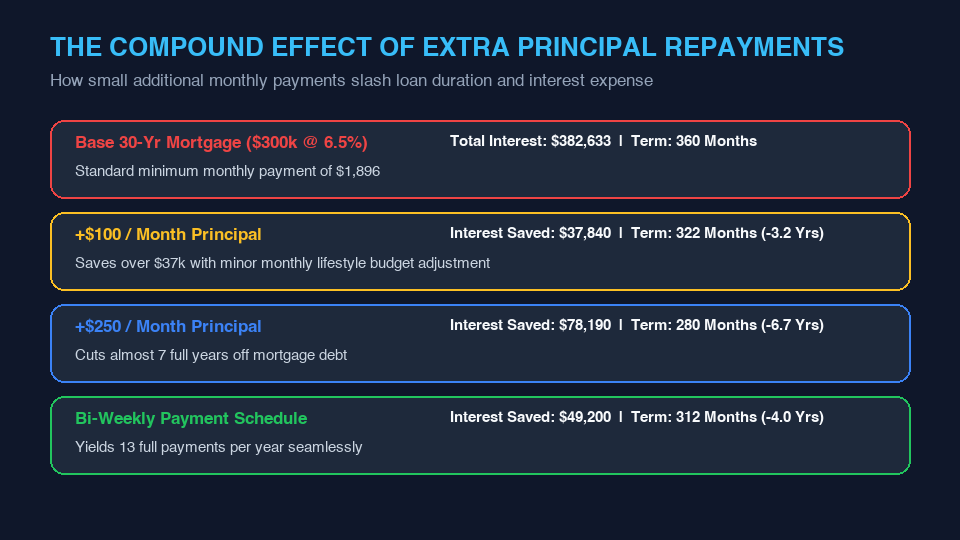
Consider a $300,000 30-year fixed loan at 6.5% interest:
- Baseline: Total interest paid over 360 months is $382,633 (more than the original loan amount!).
- Adding $100/month extra: Saves $37,840 in interest and retires the loan 3.2 years early.
- Switching to Bi-Weekly Payments: Paying half the monthly payment every two weeks results in 26 half-payments (13 full payments per year), saving $49,200 in interest and extinguishing the mortgage 4 full years ahead of schedule.
Model Your Loan Amortization Schedule
Want to see your complete monthly payoff schedule, compare loan options, or calculate how much interest extra payments will save you? Try LinkeFly's comprehensive Loan Calculator completely free.