Português
 العربية
 Deutsch
 English
 Español
 Français
 Italiano
 Русский
 Türkçe
 Tiếng Việt


Percentage Math Demystified: The Financial Guide to Markups, Profit Margins, and Price Elasticity
Stop conflating markup and margin: mastering cost-plus pricing and unit economics.
 By LinkeFly Editorial Team
In business, commerce, and personal finance, few mathematical concepts cause more catastrophic balance-sheet miscalculations than the confusion between Markup Percentage and Profit Margin. Every year, early-stage entrepreneurs, freelance contractors, and retail merchants price their products incorrectly, mistakenly assuming that adding a 50% markup yields a 50% profit margin.
In reality, mixing up cost-based markups with revenue-based margins erodes profitability, skews cash flow projections, and leads to unexpected financial distress. In this financial guide, we break down the underlying arithmetic formulas, illustrate unit economics with real-world examples, and explain break-even pricing frameworks.
1. Markup vs Profit Margin: The Critical Difference
The distinction between markup and margin comes down to the denominator: what are you dividing by?
A. Markup Percentage (Cost-Based)
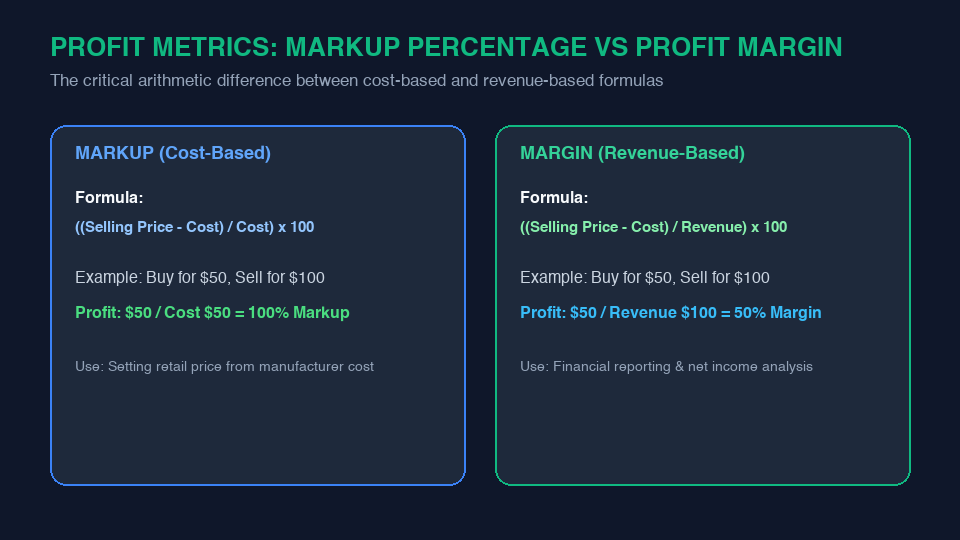
Markup expresses gross profit as a percentage of the Cost of Goods Sold (COGS). It answers: "How much higher than cost am I setting the retail selling price?"
Markup % = ((Selling Price - Cost) / Cost) x 100
If you purchase an item for $50 and sell it for $100:
Markup = (($100 - $50) / $50) x 100 = (50 / 50) x 100 = 100% Markup
B. Profit Margin (Revenue-Based)
Profit margin expresses gross profit as a percentage of the Total Selling Price (Revenue). It answers: "Out of every dollar of sales collected, how many cents remain as gross profit?"
Margin % = ((Selling Price - Cost) / Selling Price) x 100
For the same $50 cost and $100 selling price:
Margin = (($100 - $50) / $100) x 100 = (50 / 100) x 100 = 50% Margin
The Dangerous 50% Trap
If your goods cost $100 and you desire a 50% profit margin, simply adding 50% to your cost gives a selling price of $150. However, your resulting margin is only ($50 / $150) = 33.33%! To achieve a true 50% margin, your selling price must be $100 / (1 - 0.50) = $200 (a 100% markup).
2. Break-Even Unit Economics and Contribution Margins
Pricing strategy goes beyond gross margins: businesses must generate sufficient aggregate gross margin dollars to cover fixed operating expenses (office leases, software subscriptions, salaries).
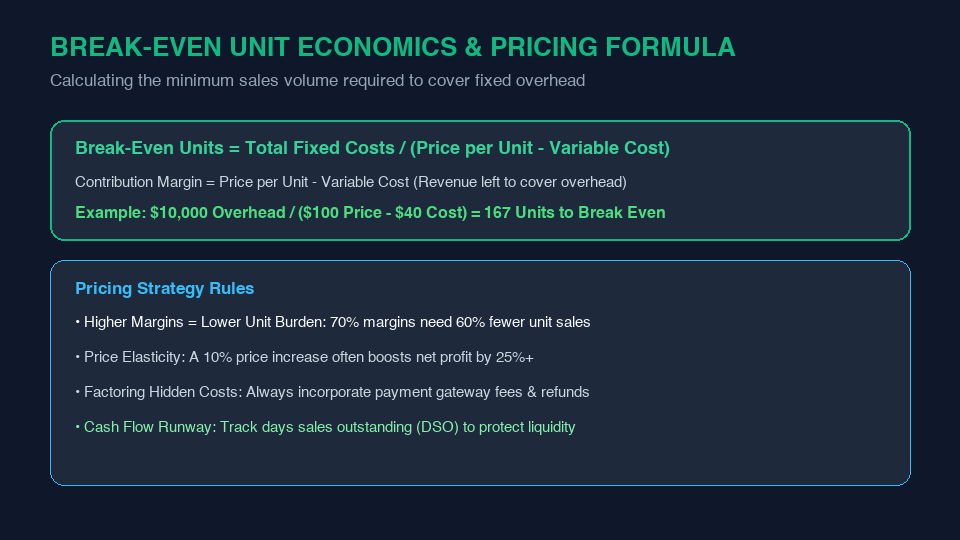
The standard break-even volume formula is:
Break-Even Units = Total Fixed Costs / (Price per Unit - Variable Cost per Unit)
The denominator (Price - Variable Cost) is your Contribution Margin. Products with high gross margins require dramatically fewer unit sales to surpass break-even and achieve sustained enterprise profitability.
Calculate Any Percentage Instantly
Need to compute markups, discounts, percentage increases, or reverse profit margins without manual spreadsheet headaches? Try LinkeFly's comprehensive Percentage Calculator for instant, error-free financial calculations.
Frequently Asked Questions (FAQ)
Margin % = Markup % / (1 + (Markup % / 100)). For example, a 50% markup produces a margin of 50 / 1.5 = 33.33%.