Português
 العربية
 Deutsch
 English
 Español
 Français
 Italiano
 Русский
 Türkçe
 Tiếng Việt


The Art and Science of Lorem Ipsum in Modern UI/UX Design and Prototyping
Why placeholder text matters, its classical 1st-century origins, and how to stress-test responsive components.
 By LinkeFly Editorial Team
In the fast-paced discipline of digital product design, few tools are as universally recognized—or as frequently misunderstood—as Lorem Ipsum. For over five centuries, typesetters and modern UI/UX engineers have relied on this scrambled Latin text to evaluate spatial layouts, establish typographic hierarchy, and build responsive prototypes without cognitive bias.
Far from being arbitrary gibberish, Lorem Ipsum carries a rich intellectual lineage originating in 45 BC. In this deep dive, we explore its classical origins, dissect the psychology of visual perception during client reviews, and examine tactical methods for stress-testing user interface components against real-world copy variations.
1. The Surprising History of Lorem Ipsum
Contrary to popular belief, Lorem Ipsum is not random synthetic code. In the 1980s, classical scholar Richard McClintock of Hampden-Sydney College traced the passage to its authentic literary source: Cicero's philosophical treatise De Finibus Bonorum et Malorum ("On the Extremes of Good and Evil"), written in 45 BC during the Roman Republic.
The standard passage begins with a truncated phrase from section 1.10.32:
"Neque porro quisquam est qui dolorem ipsum quia dolor sit amet, consectetur, adipisci velit..."
During the Renaissance in the 1500s, an unknown printer took a galley of Cicero's type and scrambled the words to construct a specimen book that showcased typeface geometries without distracting readers with philosophical arguments.
2. Cognitive Psychology: Why Designers Need Placeholder Copy
When presenting early-stage wireframes or component libraries to stakeholders, the human brain automatically seeks semantic meaning. If a mockup contains intelligible English copy—even draft text—clients and team members invariably fixate on wording, tone, and grammar rather than evaluating the layout, spacing, and interaction mechanics.
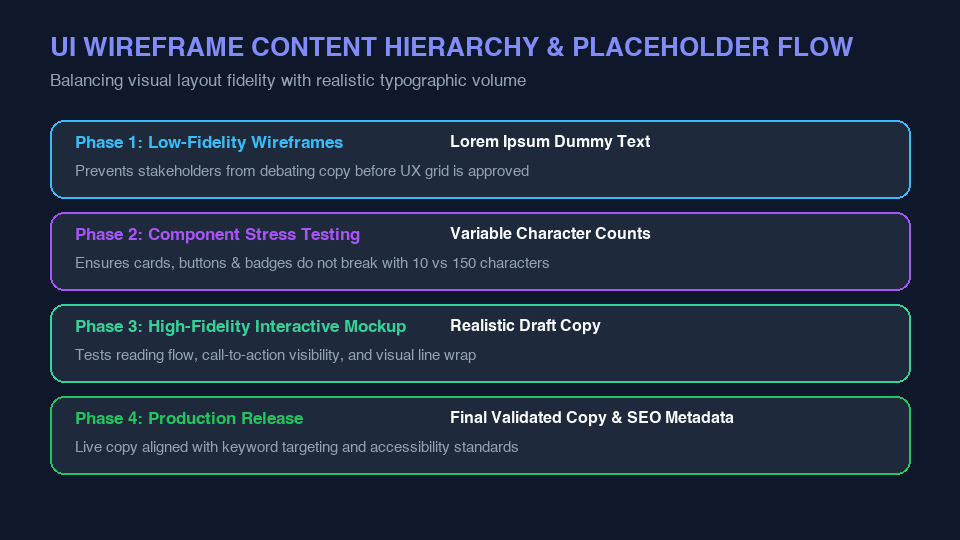
Lorem Ipsum solves this cognitive dilemma because its distribution of letters, word lengths, and sentence structures closely approximates the cadence of standard English, while remaining semantically neutral. It allows designers to focus feedback exclusively on:
- Visual balance and grid alignment
- Typographic contrast and optical line weight
- Negative space (white space) distribution
- Component responsiveness across varied viewports
3. Stress-Testing Component Boundaries with Dynamic Lengths
One of the most dangerous traps in frontend development is designing components with static, "idealized" copy. A hero card might look immaculate with exactly two words of title copy, but catastrophically break when populated with international names or long product descriptions.
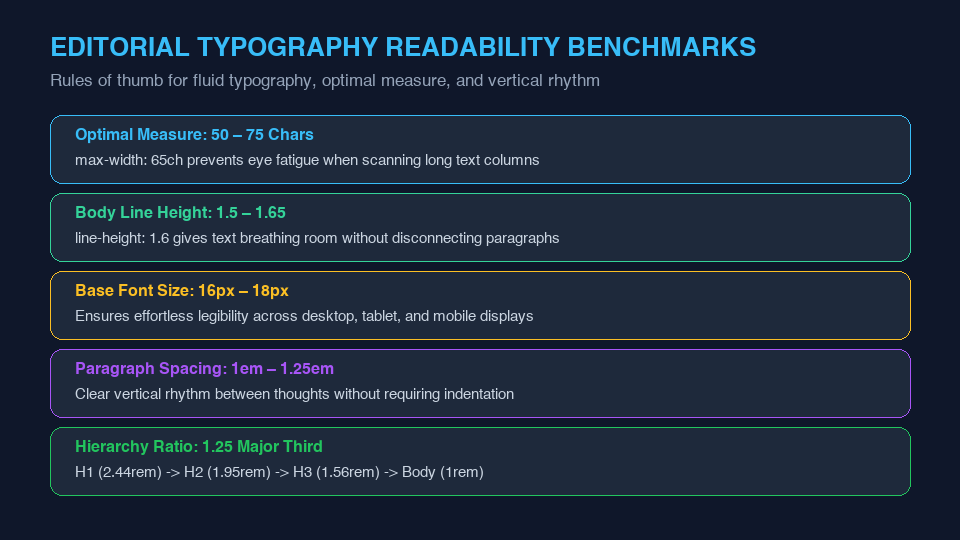
A. Testing Title Clamping and Overflow
Use variable-length dummy text to verify whether CSS text truncation (text-overflow: ellipsis;) or multi-line clamping (-webkit-line-clamp: 2;) gracefully preserves layout boundaries on mobile displays.
B. Button Wrap and Flexible Actions
Never test call-to-action buttons exclusively with short words like "Submit". Test with 25-character phrases like "Confirm Registration & Continue" to ensure buttons don't clip icons or cause horizontal viewport scrollbars.
Generate Custom Dummy Copy in Seconds
Need tailored placeholder text measured in exact paragraphs, words, or character counts? Use the free LinkeFly Lorem Ipsum Generator to instantly configure and copy clean placeholder text for Figma, Sketch, or frontend mockups.