 Italiano
 العربية
 Deutsch
 English
 Español
 Français
 Português
 Русский
 Türkçe
 Tiếng Việt


Securing Your Digital Presence: Password Entropy, Cryptographic Hashing, and Defense Strategies
Discover the mathematics of password crack times, brute-force clusters, one-way hash digests, and credential security.
 By LinkeFly Editorial Team
According to global cybersecurity breach reports, over 80% of corporate data breaches and account takeovers stem from compromised, weak, or reused passwords. Despite decades of security awareness campaigns, "123456", "password", and simple personal names consistently top annual lists of the world's most commonly leaked credentials.
In modern computing, human intuition about password strength is fundamentally flawed. People assume that replacing the letter 'a' with '@' makes a password impenetrable. In reality, modern automated GPU cracking clusters can crack an 8-character mixed password in minutes.
In this technical master guide, we explore the mathematics of password entropy, examine how brute-force cracking hardware operates, and explain the critical distinction between one-way cryptographic hashing and two-way encryption.
1. The Mathematics of Password Entropy and Crack Times
Password security is governed by information entropy (measured in bits). Entropy quantifies the mathematical randomness and unpredictability of a password string:
Entropy (Bits) = L * log2(R)
Where:
L = Length of the password
R = Size of the character pool (alphabet)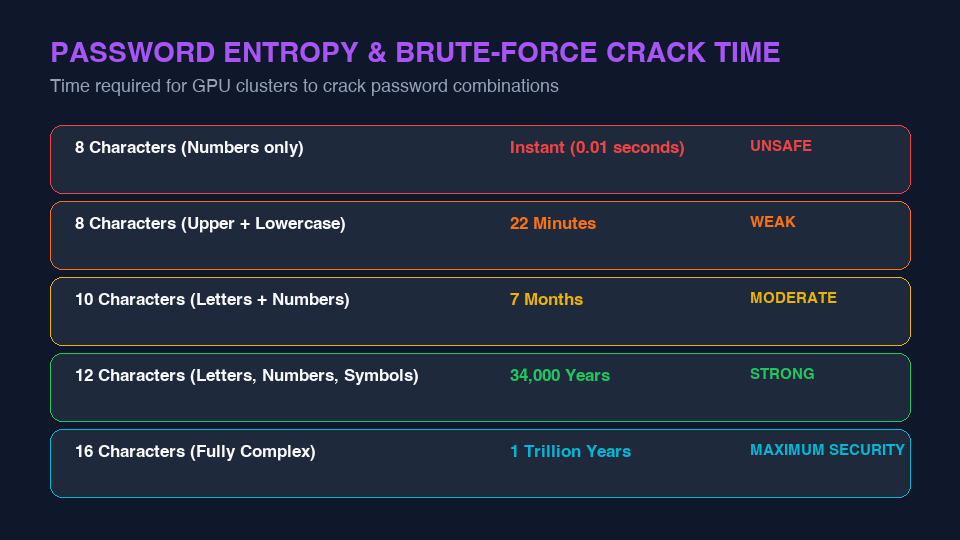
Why Length Trumps Complexity Every Time:
Consider the mathematical pool size difference:
- An 8-character password using letters, numbers, and symbols:
94^8 ≈ 6.09 x 10^15 combinations(cracked in under 8 hours). - A 16-character password using ONLY lowercase letters:
26^16 ≈ 4.36 x 10^22 combinations(takes over 138,000 years to crack!).
Increasing password length expands the combination space exponentially. A 16-character passphrase composed of four random words (e.g., correct-horse-battery-staple) is vastly stronger and far easier to remember than a complex 8-character string like P@$$w0rd.
2. One-Way Hashing vs. Two-Way Encryption
A frequent point of confusion among engineers is the distinction between cryptographic hashing and data encryption:
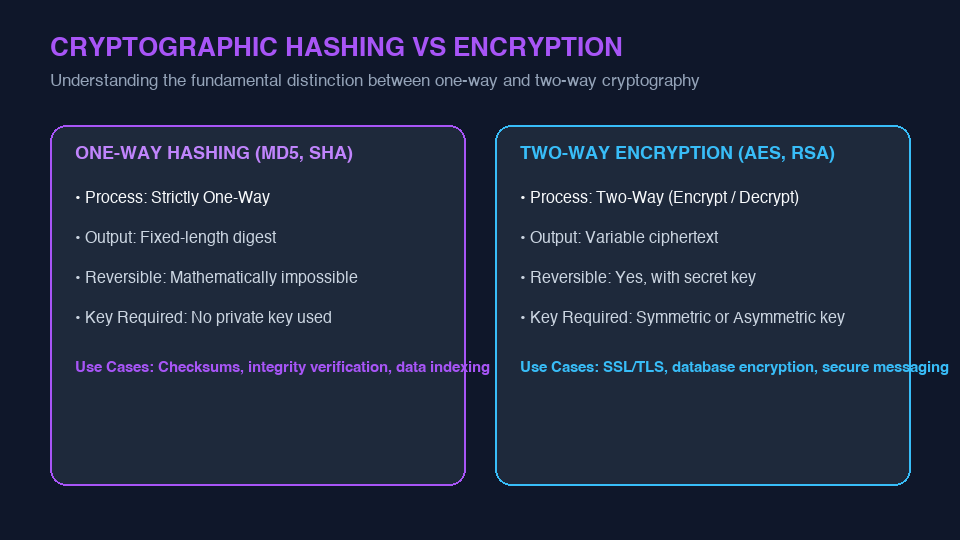
| Attribute | One-Way Cryptographic Hashing (MD5, SHA) | Two-Way Encryption (AES, RSA) |
|---|---|---|
| Directionality | Strictly One-Way (Irreversible). | Two-Way (Encrypt and Decrypt). |
| Output Format | Fixed-length digest (e.g., MD5 is always 32 hex chars). | Variable-length ciphertext based on input size. |
| Keys Required | None. Deterministic mathematical function. | Requires private/public cryptographic keys. |
| Primary Use Cases | File integrity checksums, cache keys, password verification. | SSL/TLS traffic, database column encryption, messaging. |
3. The Role of MD5 and Modern Hashing Algorithms
MD5 (Message Digest Algorithm 5) was designed in 1991 by Ronald Rivest. It produces a 128-bit hash digest. While MD5 has known cryptographic collision vulnerabilities and should never be used for password hashing in production authentication systems, it remains the universal industry standard for:
- Software Checksums: Verifying that an ISO or software installer was downloaded without corruption.
- Database Cache Keys: Generating fast, deterministic hash keys for caching database query results.
- Deduplication: Quickly identifying duplicate files in distributed cloud storage systems.
Free Security Utilities by LinkeFly
Generate cryptographically random passwords and calculate MD5 verification checksums in your browser:
4. Frequently Asked Questions (FAQ)
Conclusion
Digital security begins with proactive hygiene. By utilizing unique passphrases of at least 14 to 16 characters, storing credentials in a dedicated password manager, and enabling two-factor authentication (2FA), you build an impenetrable defense against automated cyber threats.