Français
 العربية
 Deutsch
 English
 Español
 Italiano
 Português
 Русский
 Türkçe
 Tiếng Việt


Number to Words and Roman Numerals: The Linguistic and Legal Rules of Numerical Representation
Drafting legally binding bank checks, currency text conventions, and subtractive Roman arithmetic.
 By LinkeFly Editorial Team
Numbers are the universal syntax of science and finance, yet how numbers are spelled out in words or expressed in classical notation carries immense legal, historical, and aesthetic significance. In legal contracts and commercial banking instruments (such as paper drafts and cashier's checks), the written verbal line holds supreme legal precedence over the numerical digits in the box.
Simultaneously, classical numerical systems—most prominently Roman Numerals—remain deeply entrenched across modern architecture, cinematic copyright stamps, super bowls, and horology. In this fascinating guide, we examine the legal drafting rules of financial checks, explore the subtractive logic of Roman numerals, and provide clear guides for numerical conversion.
1. Financial Check Drafting: Why Words Legally Supersede Digits
Under the Uniform Commercial Code (UCC Section 3-114), which governs commercial paper and negotiable banking instruments in most legal jurisdictions:
"If an instrument contains contradictory terms, typewritten terms prevail over printed terms, handwritten terms prevail over both, and words prevail over numbers."
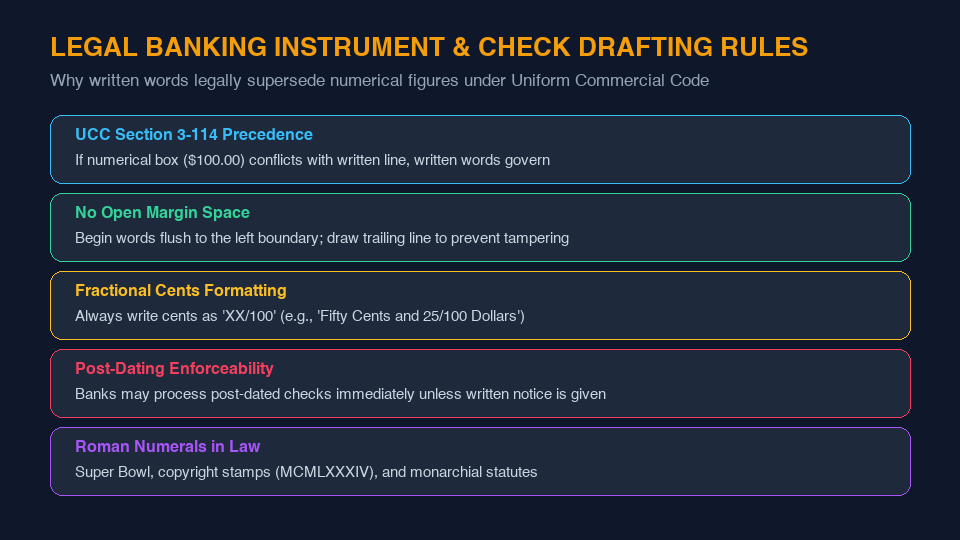
Rules for Writing Check Amounts in Words
- Start Flush Left: Always begin the written amount at the extreme left margin of the line to prevent fraudulent insertion of additional words.
- Omit the Word 'And' in Dollars: The word 'and' is reserved exclusively to separate whole dollars from fractional cents (e.g. write "One thousand two hundred fifty and 00/100 Dollars", not "One thousand and two hundred...").
- Fractional Cents Representation: Express cents as a fraction of 100 (e.g.
45/100). - Draw a Trailing Line: Draw a horizontal strike-through line from the end of the written text to the printed word "Dollars" to eliminate blank space.
2. Roman Numeral Arithmetic and Subtractive Logic
Invented in ancient Rome between 900 and 800 BC, Roman numerals use combinations of letters from the Latin alphabet to represent values:

The standard system relies on seven basic symbols:
- I = 1 | V = 5 | X = 10 | L = 50 | C = 100 | D = 500 | M = 1,000
The Subtractive Principle
To avoid writing four consecutive identical symbols (such as IIII or XXXX), subtractive notation places a smaller numeral before a larger one:
IV= 5 - 1 = 4 |IX= 10 - 1 = 9XL= 50 - 10 = 40 |XC= 100 - 10 = 90CD= 500 - 100 = 400 |CM= 1000 - 100 = 900
Crucially, you can only subtract a power of ten (I, X, C) from the next two higher symbols. For example, 99 is written as XCIX (90 + 9), never as IC!
Convert Numbers Instantly on LinkeFly
Need to format check values in written words or translate dates and numbers into classical Roman numerals? Utilize the free Number to Word Converter and Number to Roman Numerals Tool on LinkeFly for instant conversions.
Frequently Asked Questions (FAQ)
IIII for visual symmetry. On a circular dial, IIII balances the heavy visual weight of VIII on the opposite side. Additionally, in ancient Rome, IV were the initial letters of Jupiter (IVPPITER in Latin), and Romans avoided placing the name of their supreme god on mundane timekeeping instruments.MMMCMXCIX). Numbers 4,000 and above historically required an overline (vinculum) to denote multiplication by 1,000.